Most Erasmus+ proposals are not rejected because the idea was bad. They are rejected because of avoidable mistakes in structure, clarity, and alignment with programme expectations.
After supporting organisations across Europe through the proposal process, the same issues appear repeatedly in unsuccessful applications. This guide walks through the 10 most common mistakes — what they are, why they matter to evaluators, and how to avoid them.
1. Starting With a Vague Project Idea
Erasmus+ does not fund general ambitions. It funds specific solutions to clearly identified needs.
Proposals that open with broad intentions — “we want to promote inclusion” or “we aim to improve digital skills” — immediately lose ground with evaluators. If the problem is not sharp, nothing else in the proposal can be sharp either.
A strong project idea answers three questions from the start:
- What specific problem exists?
- Who is directly affected by it?
- What concrete change will the project create?
The clearer your idea, the stronger every section that follows.
2. Poor Alignment With Erasmus+ Priorities
Erasmus+ is a policy-driven programme. Projects are evaluated not only on quality but on how directly they contribute to European priorities — inclusion and diversity, digital transformation, environmental sustainability, and democratic participation.
Weak applications mention priorities once, usually near the end, as an afterthought. Strong applications weave priority alignment throughout every section — objectives, activities, outputs, and impact.
If an evaluator cannot see the connection clearly, they will score it as weak — regardless of how good the project idea actually is.
3. Confusing Objectives With Activities
This is one of the most damaging structural mistakes in Erasmus+ proposals — and one of the most common.
Objectives describe change. Activities describe actions.
“Organise three training workshops” is not an objective — it is an activity. “Improve the digital competences of 60 youth workers across three countries” is an objective.
Every activity in your proposal should clearly and logically support at least one objective. When this connection is missing or unclear, the entire project logic breaks down in the evaluator’s eyes.
4. Weak or Artificial Partnerships
Partnership quality is a core evaluation criterion — particularly for KA210 and KA220 cooperation projects.
Evaluators can quickly identify partnerships that exist only to meet formal requirements. These partnerships typically show no clear division of roles, unbalanced contributions, and no real rationale for why each organisation is involved.
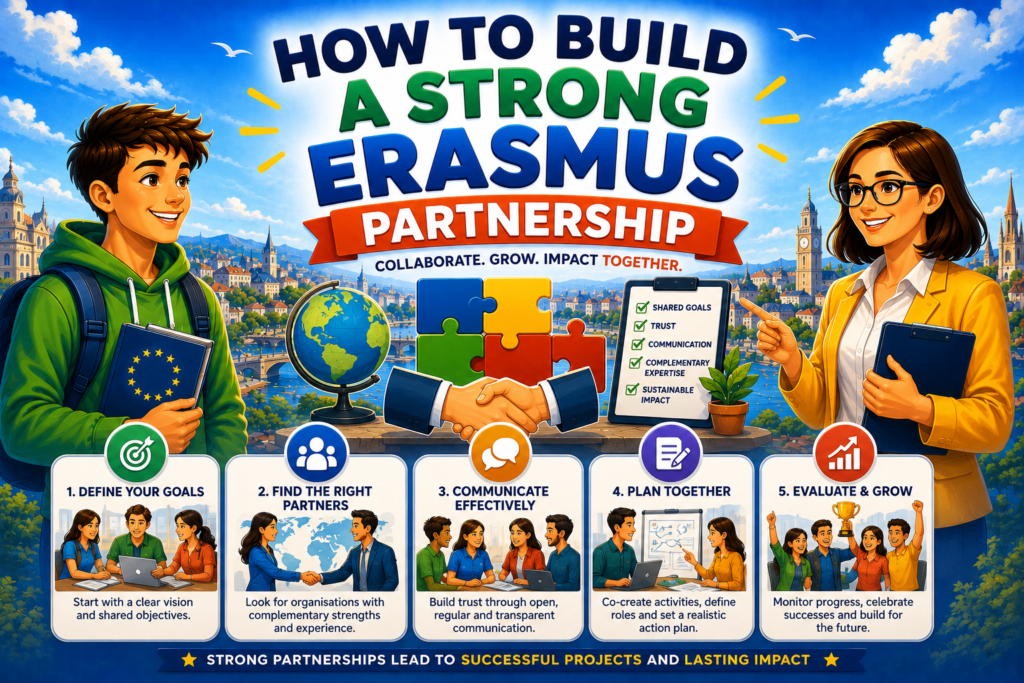
Strong partnerships are built on complementary expertise. Each partner should bring something the others do not have — and your proposal should explain exactly what that is and why it matters for the project’s success.
5. An Unclear or Unrealistic Work Plan
A strong idea with a weak work plan will not be funded.
Evaluators need to believe the project can actually be implemented as described. Overloaded schedules, vague task descriptions, and timelines that do not match the project’s scope all raise serious doubts about delivery capacity.
Clarity and feasibility score higher than ambition. A realistic work plan that is easy to follow is far more convincing than a complex one that is hard to verify.
6. Ignoring Impact and Sustainability
Many proposals describe activities in detail but fail to explain why the project matters beyond its funding period.
Erasmus+ prioritises lasting impact. Evaluators want to see what changes at individual, organisational, and community level — and how those changes continue after the project ends.
Sustainability does not have to mean additional funding. It can mean continued use of outputs, integration of results into organisational practice, or ongoing collaboration between partners. Whatever form it takes, it needs to be clearly described.
7. A Weak Dissemination Strategy
Dissemination is consistently underestimated. Many applications treat it as a box to tick rather than a strategic component of the project.
Projects that do not demonstrate a credible plan for sharing results are seen as having limited European added value — which directly affects the score.
A strong dissemination strategy identifies specific target audiences, defines clear messages, selects appropriate channels, and maps activities to a realistic timeline. “We will use social media and organise a final conference” is not a strategy.
8. A Budget That Does Not Match the Project
Even with Erasmus+ simplified budget models, inconsistencies between the budget and the work plan are a serious red flag.
If your budget does not clearly reflect your activities — or if numbers across different sections contradict each other — evaluators will question whether the applicant truly understands the programme.
Every budget line should be traceable back to a specific activity. Consistency across all sections builds evaluator confidence.
9. Poor Writing and Structure
Good proposals are not just well-planned — they are well-communicated.
Evaluators read large volumes of applications under time pressure. Unclear language, repetitive explanations, and poorly structured answers reduce comprehension and scoring — even when the underlying project is strong.
Clear writing means short sentences, logical structure, and precise language. It does not mean impressive vocabulary or complex phrasing. The proposals that score highest are almost always the easiest to read.
10. Submitting Without an External Review
Project teams are often too close to their own ideas to spot the gaps that evaluators will immediately notice.
Before submitting, ask someone outside the team to read the proposal. Do the objectives make sense without prior knowledge? Is the partnership logic clear? Does the work plan feel realistic?
External feedback — even from a non-specialist — regularly surfaces issues that significantly improve the final submission.
Final Thoughts
The difference between a funded and an unfunded Erasmus+ proposal is rarely the quality of the idea. It is almost always the quality of how that idea is structured, communicated, and aligned with what evaluators are actually looking for.
Understanding these mistakes is the first step. Avoiding them consistently is what separates competitive proposals from the rest.
Ready to write your Erasmus+ proposal?
ErasmusForge guides you through every section — structured, step by step, with built-in AI assistance and evaluation scoring.